Understanding the Scope of CIDRAP’s Vaccine Integrity Project

Summary
The Vaccine Integrity Project aims to maintain evidence-based US vaccination guidance amidst a dynamic federal policy landscape, although questions remain about the project’s role in the current immunization policy structure.In late April, the Center for Infectious Disease Research and Policy (CIDRAP) at the University of Minnesota announced the creation of the Vaccine Integrity Project (VIP) “dedicated to safeguarding vaccine use in the US.” The first step for its eight-person steering committee is to conduct listening sessions with immunization professionals to understand how non-governmental bodies may engage in the vaccine policy landscape.
Given the current structure of US immunization guidelines and policy development, it remains to be seen how the VIP will be integrated as it evolves. Below, we explore four outstanding questions that will help interpret the role and impact of the VIP within the vaccine ecosystem.
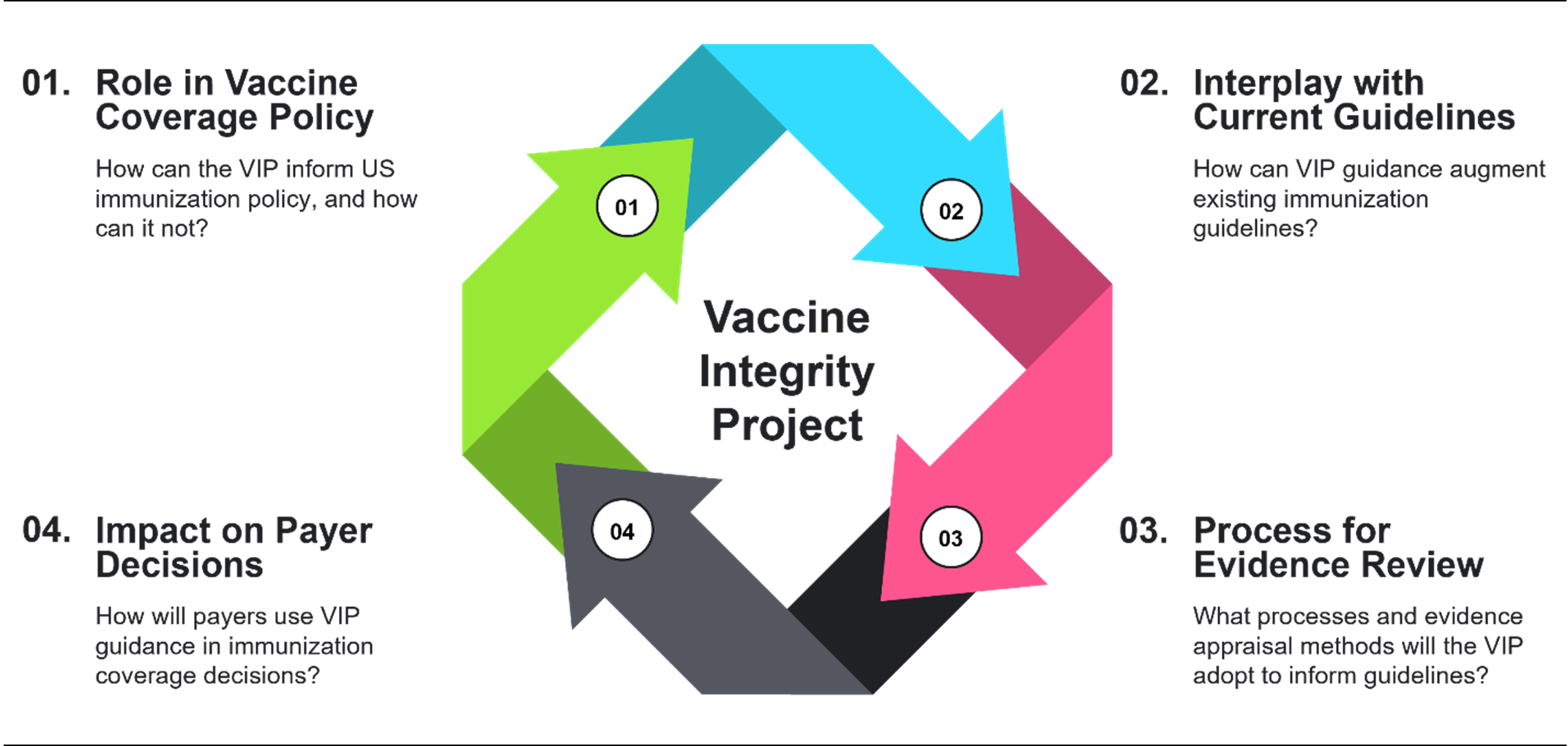
1. How can the VIP inform US immunization policy, and how can it not?
In a press release announcing the launch of the VIP, CIDRAP Director Dr. Michael Osterholm alluded to environmental changes that may impact current science-based vaccine recommendation processes and safety and effectiveness data appraisals. This announcement follows a two-month delay of a scheduled Advisory Committee on Immunization Practices (ACIP) meeting and the cancellation of a Food and Drug Administration (FDA) advisory committee meeting to formulate strain composition for the 2025-2026 seasonal influenza vaccine. These deviations from longstanding vaccine evidence review and recommendation processes have raised concerns among immunization stakeholders, many of whom rely on ACIP recommendations to guide their vaccination policies and practices.
The ACIP formulates recommendations for vaccine use based on a robust review of clinical, safety, and cost-effectiveness data. These recommendations then require endorsement by the Director of the Centers for Disease Control and Prevention (CDC) and subsequently inform federal coverage policy. Most clinical societies adopt ACIP recommendations or leverage the clinical considerations for healthcare professionals and public health officials to develop protocols for specific patient populations.
2. How can VIP guidance augment existing immunization guidelines?
Several medical professional societies develop immunization guidelines. Specifically, the childhood and adolescent immunization schedules, which are reviewed and voted on annually by the ACIP, are subsequently approved by the American Academy of Pediatrics, the American Academy of Family Physicians (AAFP), and the American College of Obstetricians and Gynecologists (ACOG). The adult schedule is approved by AAFP, ACOG, the American College of Physicians, and the American College of Nurse Midwives.
Current society immunization guidelines mirror the ACIP’s recommendations and clinical considerations (e.g., vaccine use in special populations, like immunocompromised individuals). Absent these recommendations and additional guidance from the ACIP, societies may conduct their own guideline development processes for vaccination and look to the VIP to inform them. Conversely, the VIP may seek participation from these medical societies to inform its own vaccine evaluation and clinical guidance formulation.
3. How will the VIP review clinical and economic evidence for new products to inform guidance?
The ACIP maintains a systematic evidence review process to inform its vaccine use recommendations. Separately, guideline-developing medical societies also maintain their own evidence review processes, which may or may not align with federal advisory frameworks. While it is unclear how the VIP will review evidence going forward, it may draw from current examples to inform its own framework. A process that aligns more closely with current federal standards (e.g., the ACIP’s Evidence to Recommendations framework) may allow for more seamless integration into the existing policy environment, while aligning with any number of medical societies may support a centralized, accessible repository of guidance across provider types.
4. How will payers use VIP guidance in immunization coverage decisions?
Federal law anchors vaccine coverage without cost sharing to ACIP recommendations for most insurance coverage markets, with some exceptions:
- Medicare Part B: Vaccines explicitly stated in statute (i.e., pneumococcal, influenza, hepatitis B, and COVID-19) are covered without cost sharing.
- Vaccines for Children (VFC): Coverage under the VFC program is dependent on associated resolutions, which are voted on and approved by the ACIP. While these resolutions are also ACIP-driven, they are separate from recommendations for use.
VIP guidance on its own would not result in similar coverage mandates. If current vaccination recommendation processes change significantly, payers may turn to guidance from the VIP to inform their coverage policies. Payers may choose to cover immunizations regardless given their cost-effectiveness.
As VIP guidance would not trigger mandates for vaccine coverage without cost sharing, payers may continue to lean on ACIP recommendations and the immunization schedules to inform their coverage policies. However, if current policies were meaningfully changed, payers may increasingly rely on VIP guidance. More specifically, VIP guidance could provide clarity on populations recommended to receive an immunization based on their disease risk, informing how and for whom payers cover the immunization. Absent any federal coverage requirements, payers may also choose to implement cost sharing or other utilization management tactics.
How We Can Help
As the federal vaccine policy landscape continues to change, other non-governmental stakeholders are stepping in to address potential gaps. Stakeholders should continue to remain adaptable to shifting federal priorities and prepare to engage new and emerging voices in immunization. To learn how Avalere Health can help you prepare flexible vaccine policy engagement and evidence generation strategies in the face of uncertainty, connect with us.
Related Content



Services
From beginning to end, our team synergy
produces measurable results. Let's work together.
produces measurable results. Let's work together.