Part D Cost Pressures May Shape Future Alzheimer’s Drug Management

Summary
As new Alzheimer’s drugs are developed, increased plan liability pressures may shape future Part D plan management strategiesSeveral new disease-modifying Alzheimer’s disease (AD) treatments have come to market in recent years as intravenous administrations, but as of May 2025, none of these have been launched in the pharmacy benefit. With growing prevalance of AD in the Medicare population, Part D liability (i.e., the portion of drug costs paid by plans) for new AD treatments will be a focus for Part D plans.
Today, generics like donepezil and memantine are used to manage cognitive symptoms of AD. To assess potential Part D plan liability exposure for future AD treatments, Avalere Health analyzed average Part D plan liability for beneficiaries taking donepezil or memantine. Based on 2019 Prescription Drug Event (PDE) data, seven out of the top 10 plan sponsors by total Part D enrollment had Part D liability ratios greater than 1.0 for beneficiaries taking donepezil or memantine. This means that the average Part D plan liability for enrollees taking these medications was higher than the plans’ financial liability for the average enrollee.
All Part D plan segments—except Medicare Advantage Prescription Drug Plan (MA-PD) Special Needs Plans (SNPs)—had higher average Part D financial liability for beneficiaries taking donepezil or memantine compared to that of all enrollees in 2019 (Figure 1). Compared to other plan segments, enhanced standalone Prescription Drug Plans (PDPs) had the highest Part D liability for enrollees taking donepezil or memantine. While MA-PD SNPs had the highest average per beneficiary Part D liability for enrollees taking these AD medications ($4,193), average Part D liability for these beneficiaries was lower than average per beneficiary liability across all other enrollees ($4,476).
Figure 1. Average Plan Liability Per Beneficiary for All Enrollees vs. for Enrollees Taking Donepezil or Memantine, by Plan Segment, 2019
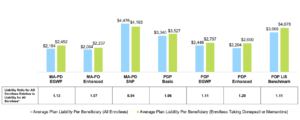
*Liability ratio is equal to the average plan liability per beneficiary for enrollees taking donepezil or memantine divided by the average plan liability per beneficiary across all enrollees in the plan segment.
EGWP: Employer Group Waiver Plan; LIS: Low-Income Subsidy
As pharmacy benefit AD treatments continue to be developed, manufacturers will need to consider the potential utilization and cost impacts of these treatment options as part of their plan contracting strategies. With increased plan liability under the Inflation Reduction Act’s Part D benefit redesign, plans are implementing various coverage, cost-sharing, and utilization management strategies to control drug costs. As enrollment in MA-PDs continues to grow, plan sponsors may be more likely to consider the total liability impact for these therapies across Part B and Part D benefits, including ancillary treatment costs and potential cost offsets. Other factors, such as clinical classification and Part D risk adjusted payments are also likely to factor into plan and manufacturer contracting strategies.
Methodology
Avalere Health analyzed 2019 PDE data, access by Avalere Health via a research-focused Data Use Agreement DUA with the Centers for Medicare & Medicaid Services. Avalere Health identified beneficiaries taking donepezil or memantime in 2019. Drug spend and liability were then analyzed to better understand net plan liability by segment for AD patients relative to overall enrollment. Plan segment was defined at the beneficiary level representing the plan segment in which the beneficiary was enrolled for the plurality of enrolled months by year. In cases where beneficiaries had the same number of enrollment months in multiple segments, the latest plan segment in 2019 was chosen.
Related Content